Finding all Windows Services using WMI in C# .NET

In this post we saw how to retrieve all logical drives using Windows Management Instrumentation – WMI -, and here how to find all network adapters.

Say you’d like to get a list of all Windows Services and their properties running on the local – “root” – machine, i.e. read the services listed here:
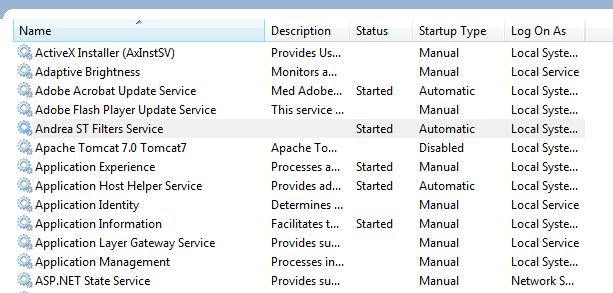
Services window

The following code will find all non-null properties of all Windows services found:

Read more of this post

Lambda expressions in Java

Introduction

If you’re familiar with .NET then you already know what Lambda expressions are and how useful they can be. They were not available in Java before version 8. Let’s investigate how they can be applied in Java.

First example: an interface method with a single parameter

Say you have the following Employee class:

Read more of this post

Running a task on a different thread in Java 8

Occasionally it can be worth putting a task on a different thread so that it doesn’t block the main thread. Examples include a task that analyses heavy files, a task that sends out emails etc. If we put these tasks on a different thread and don’t wait for it to return a result then it’s called the fire-and-forget pattern. We start a new thread and let it run in the background. The task on the different thread is expected to carry out its functions independently of the main thread.

Let’s imagine that the following greetCustomer method is something we want to run on separate thread so that the main thread is not blocked:

Read more of this post

A resource of free images for your front-end web project

Here comes another tip if you’re looking for free images as placeholders for your front-end web development: Unsplash

The site has a wide range of categories to search for suitable images and it’s all free of charge although crediting is appreciated.

Joining common values from two sequences using the LINQ Intersect operator

Say you have the following two sequences:

string[] first = new string[] {"hello", "hi", "good evening", "good day", "good morning", "goodbye" };
string[] second = new string[] {"whatsup", "how are you", "hello", "bye", "hi"};

If you’d like to find the common elements in the two arrays and put them to another sequence then it’s very easy with the Intersect operator:

IEnumerable<string> intersect = first.Intersect(second);
foreach (string value in intersect)
{
	Console.WriteLine(value);
}

The ‘intersect’ variable will include “hello” and “hi” as they are common elements to both arrays.

Read more of this post

Determine if two sequences are equal with LINQ C#

Say you have two sequences of objects:

string[] bands = { "ACDC", "Queen", "Aerosmith", "Iron Maiden", "Megadeth", "Metallica", "Cream", "Oasis", "Abba", "Blur", "Chic", "Eurythmics", "Genesis", "INXS", "Midnight Oil", "Kent", "Madness", "Manic Street Preachers"							 , "Noir Desir", "The Offspring", "Pink Floyd", "Rammstein", "Red Hot Chili Peppers", "Tears for Fears"						 , "Deep Purple", "KISS"};

string[] bandsTwo = { "ACDC", "Queen", "Aerosmith", "Iron Maiden", "Megadeth", "Metallica", "Cream", "Oasis", "Abba", "Blur", "Chic", "Eurythmics", "Genesis", "INXS", "Midnight Oil", "Kent", "Madness", "Manic Street Preachers"							 , "Noir Desir", "The Offspring", "Pink Floyd", "Rammstein", "Red Hot Chili Peppers", "Tears for Fears"						 , "Deep Purple", "KISS"};

If you’d like to check whether the two sequences include the same elements then you can use the SequenceEquals LINQ operator:

Read more of this post

Joining unique values from two sequences with the LINQ Union operator

Say you have two sequences of the same object type:

string[] first = new string[] {"hello", "hi", "good evening", "good day", "good morning", "goodbye" };
string[] second = new string[] {"whatsup", "how are you", "hello", "bye", "hi"};

You’d then like to join the two sequences containing the values from both but filtering out duplicates. Here’s how to achieve that with the first prototype of the LINQ Union operator:

Read more of this post

A Hex to RGB converter for your front-end web project

Here comes a quick tip for you who want to convert hexadecimal colour codes into RGB values: HEX to RGB converter

The background of the tool changes as you enter the hexadecimal value into the simple form in the middle of the page.

A colour scheme generator for your web project

Here’s a quick tip if you need to get some ideas about colour schemes that work well for HTML pages: Coolors IO.

It’s a free resource that can save you a lot of time if you are not a front-end designer but need a palette of 3-4 colours for the background, fonts, columns etc. Click on the Explore link in the top right hand menu and you’ll get a large amount schemes. The colour codes and names are also available for your CSS file.

Placeholder image generator for quick HTML page mockups

If you need a number of placeholder images to fill a web page just for testing then the following resource if for you: Lorem pixel.

Examples:

…and there’s much more. If you need placeholder images for your web project then make sure you check out this resource.

Elliot Balynn's Blog

A directory of wonderful thoughts

Software Engineering

Web development

Disparate Opinions

Various tidbits

chsakell's Blog

WEB APPLICATION DEVELOPMENT TUTORIALS WITH OPEN-SOURCE PROJECTS

Once Upon a Camayoc

ARCHIVED: Bite-size insight on Cyber Security for the not too technical.