Finding all WMI class names within a WMI namespace with .NET C#

In this post we saw an example of using WMI objects such as ConnectionOptions, ObjectQuery and ManagementObjectSearcher to enumerate all local drives on a computer. Recall the SQL-like query we used:

ObjectQuery objectQuery = new ObjectQuery("SELECT Size, Name FROM Win32_LogicalDisk where DriveType=3");

We’ll now see a technique to list all WMI classes within a WMI namespace. First we get hold of the WMI namespaces:
Read more of this post

Finding all Windows Services using WMI in C# .NET

In this post we saw how to retrieve all logical drives using Windows Management Instrumentation – WMI -, and here how to find all network adapters.

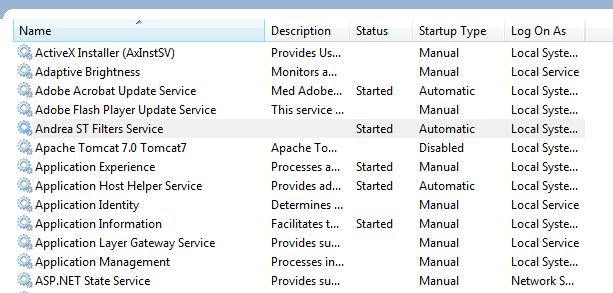
Say you’d like to get a list of all Windows Services and their properties running on the local – “root” – machine, i.e. read the services listed here:

Services window

The following code will find all non-null properties of all Windows services found:

Read more of this post

Joining common values from two sequences using the LINQ Intersect operator

Say you have the following two sequences:

string[] first = new string[] {"hello", "hi", "good evening", "good day", "good morning", "goodbye" };
string[] second = new string[] {"whatsup", "how are you", "hello", "bye", "hi"};

If you’d like to find the common elements in the two arrays and put them to another sequence then it’s very easy with the Intersect operator:

IEnumerable<string> intersect = first.Intersect(second);
foreach (string value in intersect)
{
	Console.WriteLine(value);
}

The ‘intersect’ variable will include “hello” and “hi” as they are common elements to both arrays.

Read more of this post

Determine if two sequences are equal with LINQ C#

Say you have two sequences of objects:

string[] bands = { "ACDC", "Queen", "Aerosmith", "Iron Maiden", "Megadeth", "Metallica", "Cream", "Oasis", "Abba", "Blur", "Chic", "Eurythmics", "Genesis", "INXS", "Midnight Oil", "Kent", "Madness", "Manic Street Preachers"							 , "Noir Desir", "The Offspring", "Pink Floyd", "Rammstein", "Red Hot Chili Peppers", "Tears for Fears"						 , "Deep Purple", "KISS"};

string[] bandsTwo = { "ACDC", "Queen", "Aerosmith", "Iron Maiden", "Megadeth", "Metallica", "Cream", "Oasis", "Abba", "Blur", "Chic", "Eurythmics", "Genesis", "INXS", "Midnight Oil", "Kent", "Madness", "Manic Street Preachers"							 , "Noir Desir", "The Offspring", "Pink Floyd", "Rammstein", "Red Hot Chili Peppers", "Tears for Fears"						 , "Deep Purple", "KISS"};

If you’d like to check whether the two sequences include the same elements then you can use the SequenceEquals LINQ operator:

Read more of this post

Joining unique values from two sequences with the LINQ Union operator

Say you have two sequences of the same object type:

string[] first = new string[] {"hello", "hi", "good evening", "good day", "good morning", "goodbye" };
string[] second = new string[] {"whatsup", "how are you", "hello", "bye", "hi"};

You’d then like to join the two sequences containing the values from both but filtering out duplicates. Here’s how to achieve that with the first prototype of the LINQ Union operator:

Read more of this post

How to check whether two HashSets are equal in C# .NET

Two HashSet objects in C# are equal if they contain the same values regardless of their order in the collection.

Consider the following integer sets:

HashSet<int> intHashSetOne = new HashSet<int>()
{
	1,2,6,5,7,5
};

HashSet<int> intHashSetTwo = new HashSet<int>()
{
	2,2,8,5,9,4
};

HashSet<int> intHashSetThree = new HashSet<int>()
{
	6,7,5,5,2,1
};

Read more of this post

Structurally compare two arrays in .NET

In this post we saw how to determine if two arrays are structurally equal in .NET. Two arrays are said to be structurally equal if they contain the same elements in the same order.

Structural equality has a comparison counterpart: IStructuralComparable. It determines if an array comes before or after or is equal to another array based on the elements within it.

Read more of this post

Compressing and decompressing strings with BZip2 in .NET C#

There are times when you need to return a large text from a web service. The large text will then need to be handled by the recipient. In order to reduce the size of the message you can combine two simple techniques:

  • Compress the string value with a compression algorithm, such as BZip2
  • Base64 encode the resulting byte array

You will be able to send the base 64 encoded compressed string over the wire.

Read more of this post

Resolving null values in C#

Say you have a method which accepts a string parameter. The method may need to handle null values in some way. One strategy is to validate the parameter and throw an exception:

private static string Resolve(string input)
{
	if (input == null) throw new ArgumentNullException("Input");
.
.
.
}

Another strategy is to provide some default value with an if-else statement:

Read more of this post

Getting notified by a Windows Service status change in C# .NET

The ManagementEventWatcher object in the System.Management namespace makes it possible to subscribe to events within the WMI – Windows Management Instrumentation – context. A change in the status of a Windows service is such an event and it’s possible to get notified when that happens.

We saw examples of WMI queries on this blog before – check the link below – and the ManagementEventWatcher object also requires an SQL-like query string. Consider the following function:

Read more of this post

Elliot Balynn's Blog

A directory of wonderful thoughts

Software Engineering

Web development

Disparate Opinions

Various tidbits

chsakell's Blog

WEB APPLICATION DEVELOPMENT TUTORIALS WITH OPEN-SOURCE PROJECTS

Once Upon a Camayoc

ARCHIVED: Bite-size insight on Cyber Security for the not too technical.